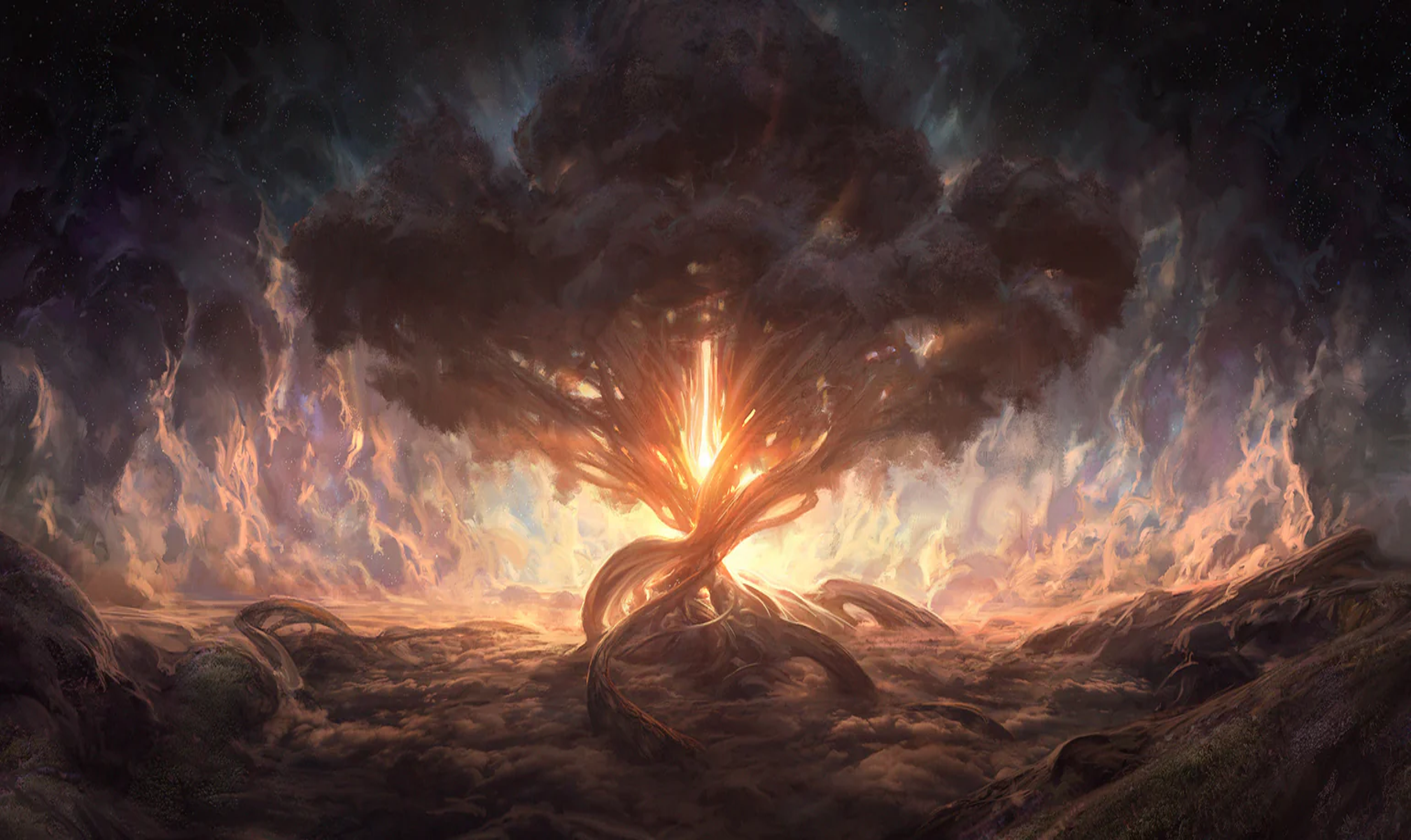
DAWN OF THE GREAT SCHISM
The root to the fracture of Edelith and the Ministry's tempered control of Solstitheo as a whole dates back to the coronation of High Priestess Ferman and the advent of the Fermanian Movement. While the prior Rondolian Movement fated and reprised an era of grandiose magnificence within the boundaries of Edelith, High Priestess Ferman rebuked the long reprise of Ronda's melody to instate an everlasting era of golden peace and prosperity. Already upon her appointment, nobility and peasantry alike were unreceptive to her complete undoing of the Rondolian Movement's principality which inspired Solstitheo's Golden Age. Particularly, while the Old Lights and religious fanatics within the Ministry heeded well to this new era, the New Lights and working class were irked by this destabilization of a once beneficiary system. However, despite the protests by the opponents, High Priestess Ferman became head of the Ministry and the Aurumic Church.
At first, the Fermanian Movement did show promise. Fate led more and more peoples to Edelith, bringing the bounties of wealth, culture, and a brief age of innovation. Application of conjured Prominence allowed for technological experimentation, birthing the state-of-the-art Flaresnare System throughout the Western end of Edelith. This not only allowed for the swift transportation of peoples and goods, but also great renown for the scholars at Sköllarium University, transforming it into a place for pilgrimage. The previous critics and tensions still persevered, but in its initial years, the Fermanian Movement showed promise.
Cracks in this Movement first appeared in the religious sector. Under the rule of the High Priestesses throughout the four previous Movements, the church was curated as a melding of religion. To put it more precisely, all Aurumics were channeled by the Aurumic Church and the serving High Priestess would voice their will in a mortal vessel. But as High Priestess Ferman exercised power within the Aurumic Church vastly beyond the precedent of prior Movements, even the most pious questioned the absolution their leader brought. Most declarations were much less true to what the citizens of Solsitheo desired from their patron and more towards a consolidation of power within the Ministry. In particular, the brutal labor of the lower classes to drain the inner bay and construct the Umbra, a utopian project proposed by the Old Light, was being unchallenged contrary to the citizenry’s prayers. And as the intensity of these religious acts and sacrifices to the Aurumics increased, an initial doubt of High Priestess Ferman festered into a tense dismissal and even betrayal of her followers.
In belief that her word couldn’t be trusted, the people turned to lesser prophets. Interdicted by the Ministry since the Sonatan Movement, undermined trust in the High Priestess led to blasphemous communion with the gods unsanctioned by the Church. And, in an act of heresy not seen since the amply named Heretical Movement, disorganized prophets stood in opposition to a High Priestess in their preachings. The High Priestess’ control overall was harsh, but the signs the prophets received were graver, most by each Aurumic calling for religious dissidence not just to the Church, but to the fellow brothers in the Pantheon as well. In this act of weakness and uncertainty, the weary peoples of Edelith organized into cults and acted in open rebellion to the Aurumic Church and Ministry.
Within the streets of the capital city, protests, demonstrations, and revolts were staged under the fervor of their deity. Dispatches were sent to quell the resistance, but limited control could be exercised without spiralling into an all-out domestic war. For many New Lights took the opportunity to figurehead the movements, looking to pry power away from the High Priestess and her council of Old Lights. And as tensions rose, the ordinances from the High Priestess Ferman and the unsanctioned prophets increasingly transformed into denouncements and calls for conflict within their religion.
As such within all the babel, a direct action cannot be responsible for the violence that ensued. But whether it became of an assassination attempt on a noble, a protest spurred into street violence, or perhaps a definitive action taken by the Ministry to smother the “false” prophets, the pious followers of the Aurumics confederated each into open war with one another. As the days and nights passed by, fights between the religious fanatics and the Ministry spiraled out, leaving the city in disarray and flames. Through the capital of the Golden Nation now in anarchy, more cults to one Aurumic or another sprung up in the countryside to stake territorial claims and exercise their own holy law without the direct interference from the Ministry.
Although, some recognized their role as pawns to the greater Old Light, New Light, and High Priestess skirmish. This included some minor nobility, but mostly the laborers in the Western Fringe and Edelith Gothitas who were detached and disillusioned by the holy wars of the elite. As such, in a moment where the Ministry was stretched thin and the city faced near collapse, the Edelith Gothitas peninsula declared a full-scale revolt against Solstitheo, forming a city-state of the indentured servants. This rebel group, known as the Edelith Liberation Front (or the ELF), would be critical to the industrial function of the Immortal City. And to this day, as the Ministry mainly reoriented the uprising of the religious sects towards the incoming evil of the Wake of Steel, the ELF remained in open rebellion until the eventual fall of the Ministry and High Priestess Ferman.